Showing posts with label Pataskala. Show all posts

Wednesday, August 11, 2010

The Alward School

See this house?  It wasn't always a private residence.  Until 1928, it was a one-room school house!  It also just so happens to be the childhood alma mater of Eleanor Youmans, who attended the school from 1881 to 1886.

The Alward School, one of nine former sub-districts of the Harrison Township School District, was built in the triangular shaped lot formed by Beecher and York Roads and State Route 16 in Pataskala.  It began as a log building called Nichols School, which was replaced by a frame building in 1845.  Thirty-eight years later, in 1883, the frame structure was torn down, and a third, brick structure replaced it.  The new school, renamed Alward, cost $2,157 to construct.  Today, the original brick hides under contemporary white siding, several porches have been added to the exterior, and an inviting tire swing sways under massive trees.

Youmans composed a history and poem commemorating the school for a 1924 Alward School reunion, both of which appear in a the 7 May 1936 special "Golden" edition of the Pataskala Standard.  She writes:
Three schoolhouses have stood on the triangular field formed by the crossing of York Street and Old Columbus Road and another road which intersects Columbus Road and York Street from the north, three miles east of Pataskala.  Only the last building, built of brick in 1883, by a man named Stothard, supervised by Bert Alward, bore the name Alward School.
The ground on which the three schoolhouses stood belonged to the late Benjamin Nichols and his father before him, and was donated for the use of a school by them.  The first building, of logs, was named the Nichols School, and stood opposite the farmhouse now owned by Curtis Bowlby, facing south toward York Street, on the southwest point of the triangle.

The second building (also called Nichols School) was frame, built by B. F. Sutherland, sometime in the fifties (as the writer's father was born in 1845, attended there with his numerous brothers and sisters.)  It may have been the late forties.

No copy of the old registers is available, to ascertain the names of early teachers.  Mrs. George Nichols was a teacher there, Mrs. Ella Martin, Martha Clark; the last person to teach in the old frame schoolhouse was the late Fred Thomas, beloved by all who knew him.  He also taught the first term in the new brick schoolhouse, and subsequent term; he was followed by Elmer Morrow, Margaret Forsyth and Rosa Rogers, during the time the writer went to that school.  A list of all the teachers of these schools, which endured for over sixty years, would fill the column of a newspaper.  Sometimes there were two teachers in one year; for example, Martha Clark taught the summer term in the frame building, in 1882, and Fred Tomas taught the winter term.

It is a striking commentary upon the times, that, in the present day, when thousands of country schools have closed for lack of funds, we descendants of those who attended the Nichols School, and who ourselves attended the Alward School, can find no record of the district.  And yet we like to believe that we live in a more enlightened age.

Where we first went to school, three roads
Spread wide inviting arms,
Beckoning travelers onward,
Through hills, to peaceful farms,
A stream ran not too far away,
Forming a quiet pool
And skating pond, for childish play
Where we first went to school.

Bobolinks sang on the fence;
Bees hummed in jimpson weeds;
The air was filled with thistle down
And shining milk weed seeds;
Along the hedgerows, rabbits hid;
Green pawpaw bushes, cool,
Held nests of tiny feathered things,
Where we first went to school.

No other skies have been so blue;
Nor sunshine beamed so bright;
Birdsongs were always sweeter there
And clouds more billowing white.
No teachers ever were so kind--
Indeed, that child were fool,
Who could not learn contentment
Where we first went to school!
In addition to the school's history and the poem she wrote in its honor, there is also an image of the Alward School in the collection of glass negatives taken and owned by Youmans, which shows the structure's original brick facade.  Who knows, but maybe it's Eleanor herself posing on the front steps!


My thanks go out to Martha Tykodi for supplying a copy of the original article, and granting me access to the original glass plate negative!

Top Image: Photo of former Alward School building, now a private residence, July 2010
Bottom Image:  The Alward School, courtesy of West Licking Historical Society, from Eleanor Youmans Glass Plate Negative Collection

Tuesday, July 20, 2010

Tour of Homes

The landscape of Pataskala, Ohio, has changed quite a bit since its official establishment in 1851, and especially over the past decade, expanding from a rural village of 3,000, into a growing city of over 10,000, with a geographic range that quadrupled to its current approximate 40 square miles following a merger with Lima Township in 1996.  Every time I visit, it seems another half-dozen businesses and housing developments have popped up out of nowhere.  With this in mind, I thought I'd post some before and after photos of Eleanor Youmans' homes in Pataskala. 

Youmans was born in Maxville, Missouri, in 1876. When she was about five, she and her younger sister moved to Licking County, Ohio, to live on their grandfather's farm. The Williams homestead was located on the corner of St. Route 16 and York Street in Pataskala.  Here it is, off the "old mud pike," circa 1900:


Today, the Williams family farm has become the site of the Jefferson Ridge Condos, as pictured below:


Eleanor and her sister returned to Missouri in 1886, where she finished school and then taught for a year.  Back in Ohio in 1895, she lived with cousins in Celina, before moving to Canton.  She frequently visited her family in Pataskala during these years, and married Brigg Youmans in 1900. 

As newlyweds, Eleanor and Brigg moved into the house on the corner of Willow and Main Streets in Pataskala.  They spent their entire married life in this home, raising their son William, here.  If you look closely at the photo below, taken around 1900, you can see their dog Toodles sitting on a chair in the front lawn:


The house still stands, but the exterior has undergone a transformation, as has the street name (it was North Main when the Youmans' lived there, but it is South Main today).


William was married in the spring of 1927, and Brigg passed away that fall.  Eleanor spent a year in California, and when came back to Pataskala in 1928, she moved into the Redhead property, located on what was then North High Street, just north of the Railroad tracks, staying there until 1938. [Sorry, no before photo for this property].


After her decade in "the little five-room cottage" on High Street, she moved to a house on East Atkinson Street, which she cheekily nick-named "Grey Shingles."  According to an article by Carolyn Bentz, "the house was built by James Coons, the grandfather of Florence Coons Wilson and Aimee Coons Atkinson.  In fact, a niece was born in the house.  She was the wife of Charles and mother of Stanton and Ewing.  The house was over a hundred years old [when it was torn down]."  Pictured below circa 1945 and 1950:


Youmans resided on Atkinson until October 1968, when failing health prompted her move to the home of her son and daughter-in-law in Plain City, Ohio.  William sold the property in 1971 to the local fire department, and the house was torn down to increase the size of the fire department's parking lot:


Images from top:  Williams Farm, located on St. Rt. 16, photo courtesy of West Licking Historical Society, from Eleanor Youmans Glass Plate Negative Collection; Jefferson Ridge Condominiums on St. Rt 16, east of Pataskala; Brigg and Eleanor Youmans Home on southeast corner of Main and Willow Streets, from Eleanor Youmans Glass Plate Negative Collection, courtesy of West Licking Historical Society; House at what is now 245 South Main Street today; 291 South High Street today; East Atkinson Street house, circa 1945 courtesy of the Ohioana Library; East Atkinson Street house, circa 1950, courtesy of the Ohioana Library; Old Pataskala firehouse today, side view

Tuesday, July 13, 2010

Glass Plate Negatives, A Beaded Bag, and Pink Ladies

I knew I was in for a treat when I saw a small cardboard box labeled "Cat Pictures" in large, chalky script resting on the dining room table of West Licking Historical Society president Martha Tykodi.  I return to Ohio every summer, and this trip would include research on my writerly cousin, Eleanor Youmans.  Appointments were scheduled for the Billy Ireland Cartoon Library at Ohio State (more about that later); with Tykodi--a lifelong resident of Pataskala who, as a child, knew and admired Youmans and as an adult preserves her memory; and with Julie Brown--the daughter of Pataskala historian Carolyn Bentz, who also knew and wrote about Youmans.  

Next to the marked box containing seven glass plate negatives of Skitter, his brothers, and William, was a wooden antique cigar case holding several dozen more 4 x 5 emulsion coated plates, donated to the historical society by Bruce Baird, and a second, slightly larger, light gray metal case storing another sixteen 5 x 7 glass plate negatives given to the historical society by Virginia Gakle, a friend of Eleanor in her later years, whose husband purchased the negatives at her estate auction in 1968.

The images captured on the negatives are simply amazing.  To name but a few, there are snapshots of the elaborately furnished interior of the Youmans's Main Street home during their newly-wed years; candid shots of Eleanor's husband lounging on a chaise, cigar in hand and toddler son perched on his father's belly; photos of her son, William, with the mischievous Skitter cat as a kitten; poses of Youmans and her female friends dressed in their husband's suits and tuxes; and even an Art Nouveau inspired composition with a tastefully bare-bosomed Youmans cradling a bouquet of flowers.  What an absolute treasure this collection is.

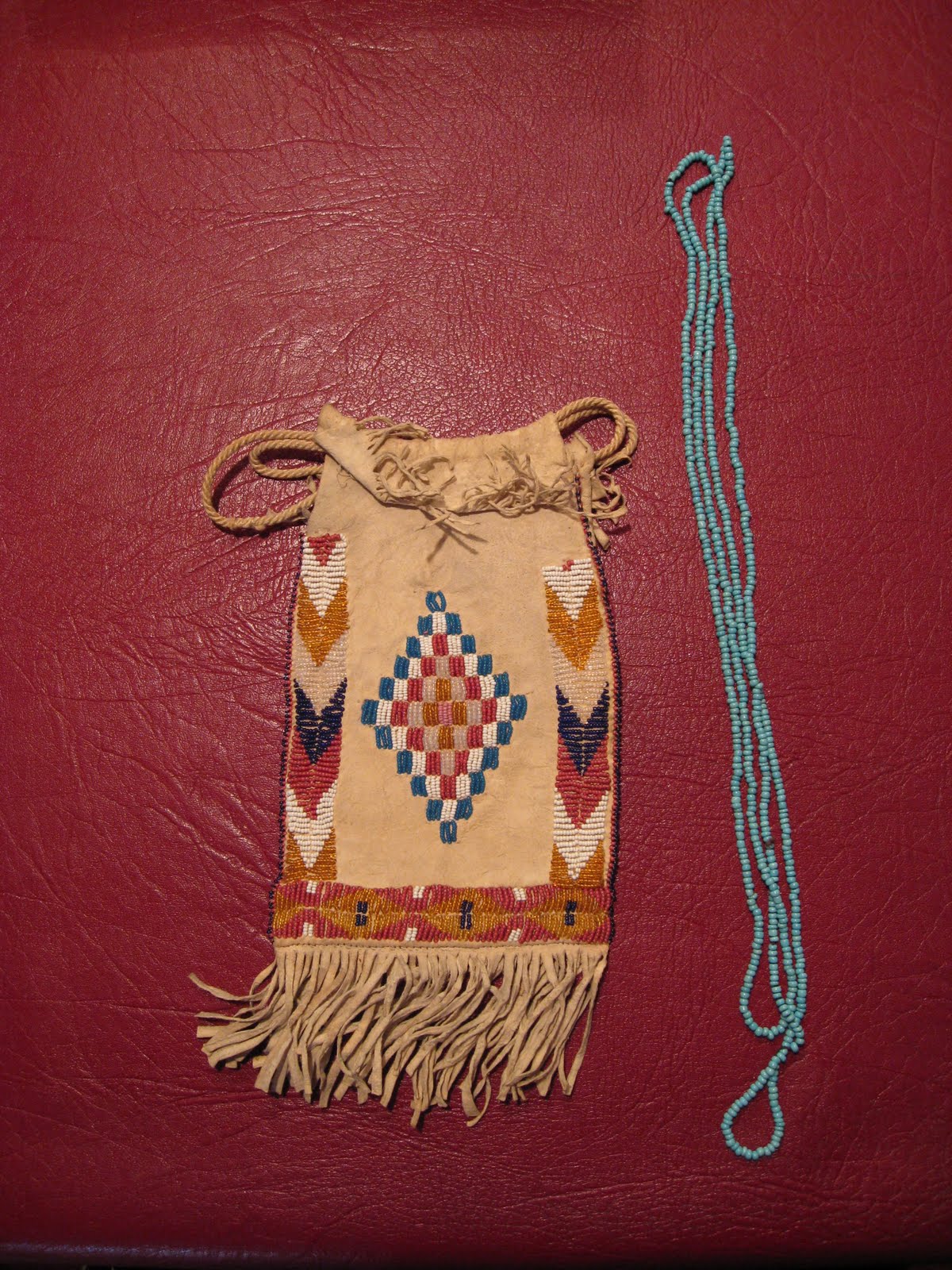
Another rare item shared during this visit belongs to Julie Brown: a beaded leather drawstring pouch she inherited from her mother that was originally given to Youmans in 1902 or 1903 by her friend Dora Jones (pictured right), along with a long strand of blue beads.  A handwritten letter inside the bag, addressed to Lena Fravel--another of my Pataskala cousins on my mother's side and friend of Youmans--explains that the bag once belonged to Sitting Bull's wife, and came from Canton, Oklahoma Territory.  The bag, however, tells a different story.  Inside, someone hand wrote the following:  Mrs. Geronimo, Apache, Canton, OT., Sept. 20, 1903.  The letter Youmans wrote to explain the bag was composed in her final weeks, and contradicts what is written inside the pouch in several ways (the fact that anything is written inside at all; the name of the Native American to whom the bag supposedly belonged, and the year Youmans obtained the bag).  Whatever its true history, the bag is beautiful.  It's clear why this artifact was so dear to Youmans.   

A huge thank you goes out to Martha, Julie, and my mom for encouraging me to study Youmans and for sharing these treasures with me!


Pictured Top Left: Judy Cruikshank, Julie Brown, Jackie Cruikshank Vogt, Martha Tykodi
Middle Right Photo: Courtesy of West Licking Historical Society, from Eleanor Youmans Glass Plate Negative Collection

Monday, July 12, 2010

Artifacts Housed in Pataskala Public Library

Pataskala librarian Cathy Lantz is the resident expert on Eleanor Youmans at the local public library.  She was kind enough to allow me to photograph several artifacts donated by the author.  See pics below:


According to the card inside the frame, this large weaving is a Tapa Cloth, "made of Mulberry Bark and decorated by the natives of the Samoan Islands."  Youmans donated the cloth to the library in 1968, most likely as she was discarding many of her belongings before moving in with her son and daughter-in-law in Plain City, Ohio, where she passed away just a few weeks later at the age of 92.

The Tapa Cloth is mentioned in Skitter and Skeet, as part of the collection of "curious things brought from many parts of the world" displayed in the home of the family's well-traveled Santa Barbara cousins (26).  I'm not sure if the trip taken by Mother, Father, Little Boy, and Skitter to California detailed in Skitter and Skeet is more fact or fiction.  The book was published in 1928, following Youmans' year long residence in California, newly widowed, empty-nested, and without Skitter, so it could be a fictionalized memory (as many of the Skitter stories seem to be), but I do wonder if it might instead be a fantasy constructed on the page, created as she worked through the dramatic changes re-scaffolding her personal life.

~ ~ ~


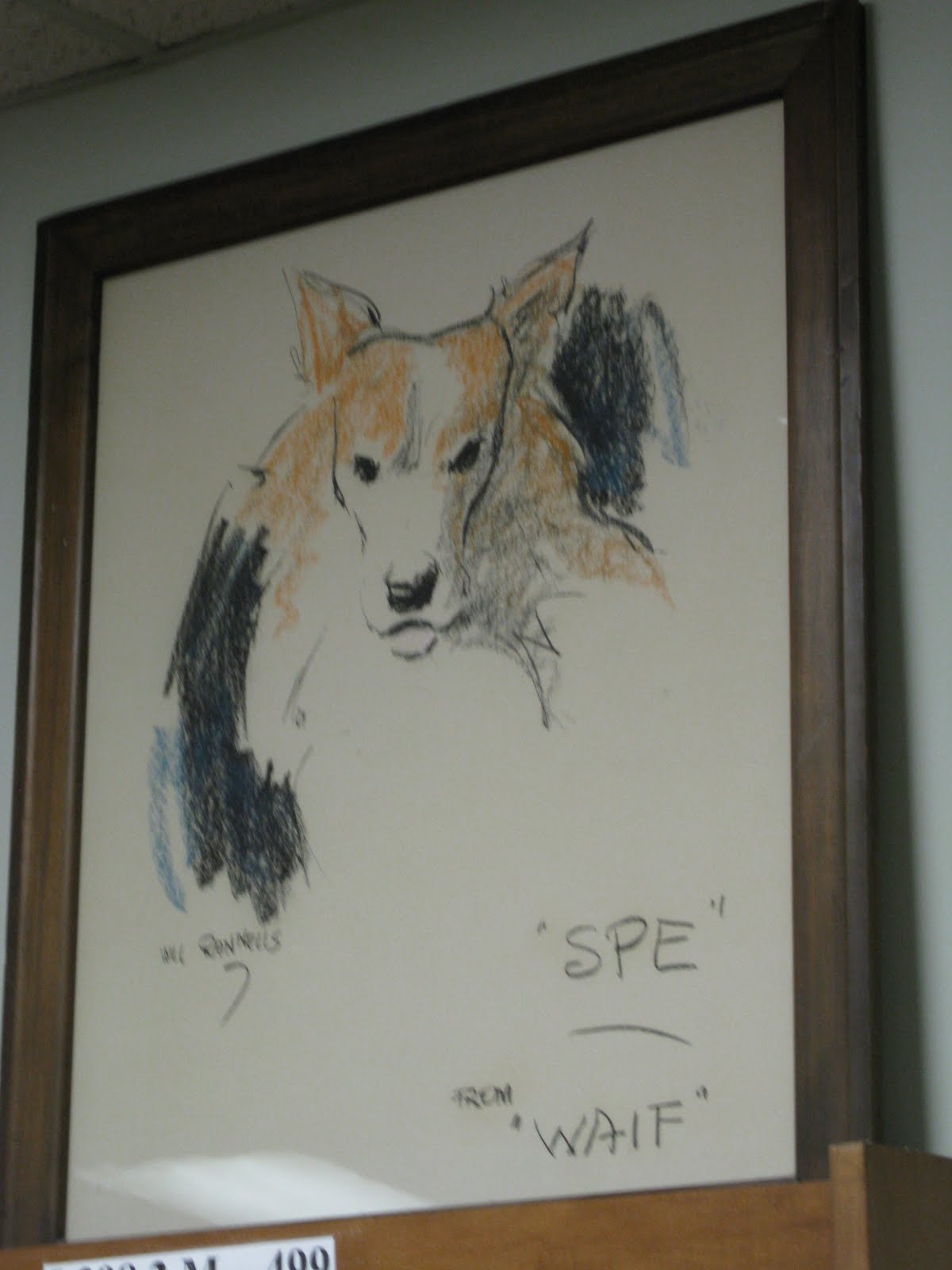
These three framed pieces are original illustrations by the famed dog portrait artist, Will Rannells, appearing in two of the three works on which he collaborated with Youmans, including Waif: The Story of Spe (1937), The Great Adventures of Jack, Jock and Funny (1938), and Timmy: The Dog That Was Different (1941).  West Licking Historical Society president Martha Tykodi recalls attending an event hosted by the library in the late 1930s / early 1940s—when the library was still located in its original home in the Pataskala Town Hall—featuring Rannells and Youmans together.


The images are on display in the children's section of the library, where they've been housed ever since I can remember.  Labels on the backs of the frames offer a date of 1976, but this was the year the library began a new inventory system, rather than the year in which the art pieces were obtained.  I suspect the portraits were probably gifts to the library from Youmans, perhaps the same year as the Tapa Cloth, as she gave away many of her possessions at that time. 


I hope these mementos will not suffer the same fate as the collection of books authored by Youmans once owned by the Pataskala library—they were donated to the Granville Historical Society.  Youmans lived all but eighteen of her ninety-two years as a Pataskala resident, and the traces of her legacy belong in her home town.

Wednesday, June 9, 2010

A Celebrity Cat

Skitter Cat (1925) was Youmans's first novel, launching a series of four tomes about the feisty white Persian kitty, three of which were reissued in The Skitter Cat Book (1947). The characters are: Aunt Maud (based on Maud Mead, wife of Eleanor's husband's nephew), who owns Fluff, a pedigreed Persian. Fluff is mama to four kittens. Three are timid, brothers Jack Frost and Snow Ball, and their sister Snow Baby. The fourth, more adventuresome brother cat they name Skitter (because of the sound his claws make when he runs across the floor, like a skittering dry leaf). Mother, Father, and Little Boy (based on Eleanor, her husband Brigg, and son William) adopt Skitter, who joins Major, their Airedale. Other supporting characters include husband and wife neighbors who own the chickens Skitter loves to chase, a friend in the city who is willing to house Skitter until he outgrows his kitten-aged urge to frighten chickens, a "big girl" and her father who live across the Pike and help return Skitter to his family after he escapes a moving car, and Minnie, the live-in maid. [A 1910 Census record lists Sadie R. Givner [Gieseck] born about 1888 (age 22) living with the Youmans family as a servant—perhaps she is the real life model for Minnie].

The hero of the story, Skitter, of course, is based on his real life namesake:


Photo of Skitter courtesy of Charles O. Davis.

The inscription Eleanor wrote in my mother's copy reads, "Skitter lived to be almost sixteen, and Major lived to be twelve. Little Boy was my son William. Eleanor Youmans, Pataskala, Ohio. Dec. 20 1944."

Pics of my very beat-up dust-jacketed edition:


Text of Front Flap
(apparently aimed at the child reader):
Skitter Cat's big adventure was getting lost for five months in the woods, and that's some adventure for a home-keeping Persian kitten.

Here were dangers the little thing had never dreamed of, but he had a lot of courage and he made up his mind that he was going to live and get back home to his warm firs and his saucer of cream.

Instinct—the head of the family can tell you what that means—comes to his rescue. He learns to hunt for his food, to know the birds and the wild animals, and all about woodcraft; the fact is, he becomes a sort of kitten Boy Scout.
Text of Back Flap (presumably aimed at the adult reader / parent buyer):
If you are unfortunate enough to dislike cats don't take this little volume into your family circle. For this is the intimate life story of a Persian kitten, a new kind of biography which you can't read without seeing Skitter Cat before the fire, without hearing his plaintive voice, without feeling his silky coat as he curls himself up in your lap.

This warning is addressed to the head of the family, for of course there isn't any child who dislikes cats, and Skitter Cat is by first intention a story for children. But you, head of the family, may have to read it aloud six nights out of seven and so we tell you it is biography of a new kind; that you won't find any nature faking in it, but animal life as it really is along with a lot of fun and some interesting information.
What I really enjoy about the story, however, is that it gives insight into early twentieth-century small town life. The location of the story is based on Pataskala, Ohio, Eleanor's hometown. Geographic clues fit the village's profile. There is the pike on which Skitter escapes the moving vehicle that sounds a bit like the viaduct just outside of town on West Broad Street crossing into Summit Station (although he is supposed to have gotten lost twelve miles from town, not two, so maybe this is just imaginative thinking on my part). The city Skitter is in transit to is presumably Columbus. Father comes home for lunch and a nap from his downtown business, an easy feat in real life, as Brigg and Eleanor lived just two blocks away from Brigg's store; and Father in the story spent his youth trapping with his brothers in the rural landscape surrounding the village—and landscape that is quickly eroding today, but nevertheless still exists.


Downtown Pataskala, circa 1910, looking North toward railroad tracks. The two story brick building with the flat front and three windows across the top is the Standard building. The building just north of it is the Youmans' Store, which burned down in 1914.

I also love that Youmans isn't afraid to "tell it like it is." She doesn't hold back from presenting cats as carnivores in her honest portrayal of survival in the woods, nor does she refrain from showing child readers the harsh realities of neglected animals. Stray cats are routinely dropped off in the alleyway beside the family’s house because, "Mother was convinced, people knew she’d see to them being put to sleep painlessly." (In other texts she is even more up front about animal life and death—and the violence inflicted on them by humans).

The best story about Skitter, though? That he was a celebrity among his child readers, receiving hundreds of requests for "Skitter-graphs," prints from Skitter's paw dipped in ink. One summer when Eleanor took an extended trip to California and Skitter stayed behind with a friend, she kept up with demand by forging skitter-graphs by borrowing a neighbor's cat and some purple ink. Skitter didn't mind too much, as he didn't like ink anyway.