Friday, September 17, 2010

Mack Comes Marching Home

A recurring character in the Skitter Cat books is Aunt Maud, who lives just down the street from Skitter's family, next to the train tracks that divide the town in half.  Like Skitter (and the train tracks) Aunt Maud is real, based on Eleanor's friend and neighbor, Maud Mauger Mead.  Maud Mead (pictured left) was wife to Brigg's nephew Merrill Elmous Mead (the son of William Mead II who co-founded Pataskala Bank with his brother-in-law Jacob S. Youmans, and whose family home in Pataskala is now the Kauber-Sammons Funeral Home).

Maud's granddaughter, Barbara Spears, very generously gave me a few pages from an original manuscript of Eleanor's eighth novel, Little Dog Mack.  The editorial marks on the pages are definitely Eleanor's, as the handwriting matches that of letters she composed prior to the 1960s (when failing eyesight presumably lead her to write in a larger, rougher script--a sharp contrast to the tight curly-ques punctuating a typed, yet hand-corrected letter to her sister, dated 1944).  The manuscript is typed on bonded paper, now yellowed.  If you turn the pages over, her editorial pen strokes have bled through to the back and turned oily brown from eighty-years of oxidation.


According to the manuscript, Little Dog Mack was once titled Mack Comes Marching Home, and his given weight went from seventeen to fifteen pounds.  (If only weight loss were so easy in real life)!  Other changes seem mostly to pare down her wordage, sharpen their meaning, or lend to more standardized speech.


In reading over the sheets--comprised of the title page and first and fifth pages of what remains of the original 61 page manuscript--I realized that I have several photos of Mack.  The story begins with Mack's naming, no easy process for his ten-year-old owners, twins Rachel and Ralph.  Whereas Rachel wants to call him "Toodles,- 'Because he is so little and cute,'"  Ralph "chose MacGregor,- for the hero of a book he liked."  Their ensuing argument is settled by their father, who suggests "MacToodles, which satisfied Rachel but left Ralph doubtful."  In the end, the dog "grew so fast, and became so valiant, that, before a great while, the latter half of his name sounded silly," and "Ralph shortened it to Mac."


When I read Little Dog Mack last winter, I hadn't yet viewed the glass plate negatives the West Licking Historical Society owns, so this passage at the time didn't strike me.  But now having viewed the collection, I realized that the handful of dog portraits labeled "Toodles" are also pictures of Mack!


You can also see Toodles in the photo of Eleanor's home on Main Street, where he is seated on the chair in the front yard!

Friday, August 20, 2010

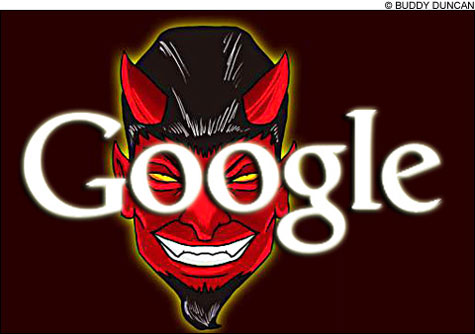
Don't Be Evil, Google--I Love You Too Well to Give You Up

Putting it mildly, the recent Google Book Settlement is certainly not all rainbows and butterflies for the publishing world--or for authors who want to retain control over their writing (read an excellent break-down of the settlement and its troubling repercussions here).  But, I confess the immediate payoff of having access--even in "snippet" form--to otherwise unsearchable data is remarkably useful to an individual researcher like myself.

"Don't Be Evil Google" image by Buddy Duncan, as posted on The Boston Phoenix "Phlog"
When I began graduate school, I enrolled in a required course that covered the basics of advanced library research, and of course I've picked up a trick or two along the way as a paid research assistant and scholar-in-training conducting my own thesis / dissertation driven research, so I know my way around print / online bibliographies and the like.  But there are, of course, always limitations to what gets recorded in the first place, or in figuring out the most useful search terms to find what is documented.  Like it or not, the Google Book Settlement has cleared a few more pathways as I recover the writing of Eleanor Youmans, and I can't help but feel excited about these new discoveries.

For months, I've been looking for her entry in Who's Who, unsuccessfully, though our university library has rows upon rows of shelves housing copies of several of its imprints.  And, just a month or two ago, I'd thoroughly exhausted all "Eleanor Youmans" searches (and its variants), including those within Google Books.  Now, seemingly overnight, there is a whole host of hits that never surfaced before.

Turns out, Youmans first appears in a 1937 volume of American Women: The Official Who's Who Among the Women of the Nation.  From this entry, I learned the titles of two other magazines in addition to Child Life in which she published short stories, one being Junior Home, and the other The Animals' Magazine (based in London, and which I'm fairly certain is the title of the English magazine that "copied" her early Cat Courier stories, inspiring her to pursue novel writing).  The Who's Who blurb also narrows her location during her year-long residence in California specifically to Santa Barbara.  Other "snippet" references lead to an article she wrote for The Writer in 1928, several more book reviews, quite a few mentions of her work in curriculum guides, and three more short stories anthologized in two Bobbs-Merrill readers.  

I'm taking an Electronic Texts course this semester, and about to begin a research assistantship with UNL's Center for Digital Research in the Humanities, so I'm looking forward to learning more about the moral and technical issues implicit in the Google Books Settlement--and in digital archiving in general.  Though I have a deep enthusiasm for Eleanor and her writing, enjoy creating a space where I can bring together the information I'm discovering about her, and hope to make her work more accessible to a larger audience, I'm often dubious about revealing too much on the web.  I don't want to infringe on any copyrights of book reviews or library holdings, or make public that which should be kept private.  Plus, if I've just spent hours, months, or even years talking with people in the know, applying for competitive library residencies, trekking cross-country to view elusive materials, scanning rare documents and images, do I really just want to give it up to the public realm so easily?  And yet, isn't sharing and disseminating knowledge--especially if it fosters greater enthusiasm and appreciation--the whole point?  Whatever the answer, in an ever-increasingly online world, the ease of posting otherwise hard-to-find material sometimes feels to me a bit slippery.